Don’t Wait to Start Living Again: Heather’s Journey
A client’s rehabilitation journey in their own words
By Heather Vaughan
My Life Before
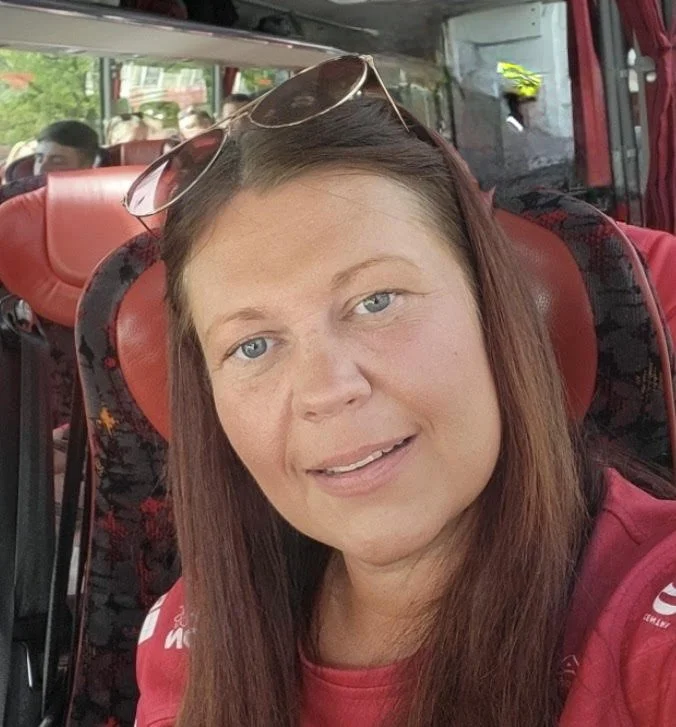
Heather on a rugby tour bus before her illness
Before all this happened, I was happy, outgoing, and bubbly. I followed my rugby team home and away, sang in the shower, went out with friends most weekends, and worked full-time. I was active, healthy, and didn't think twice about walking to a shop or eating a meal: I loved my food. Life was normal, and I never appreciated just how precious that was.
Then, at the end of January 2025, I got an earache. And everything changed.
When Everything Changed
What started as what a pharmacist called "swimmer's ear" turned out to be something far more serious. Over the following weeks, I visited doctors five or six times. I was given different antibiotics, drops, and steroids. Nothing worked. The pain was unbearable.
By March, I was admitted to the hospital, where I stayed for over three and a half months.
The fluid from the infections caused nerve damage to my brain, which led to Bell's palsy. That's seventh nerve damage that controls your facial muscles. The right side of my face dropped. My eye wouldn't shut. I had to have a weight put on my eyelid and tape my eye shut every night. My speech was affected. I was drinking from a sippy cup at 37 years old, and spending mealtimes learning to eat a yoghurt with a spoon like I was starting from scratch. For someone who loves their food, that was really hard to take.
"That was difficult because that wasn't me."
In May, I was finally diagnosed with ANCA vasculitis, a rare autoimmune disease affecting roughly 1 in 20 people per million per year, in which the body attacks its own blood vessels. The inflammation had been blocking every treatment I'd been given. By that point, I had completely lost my hearing in my right ear and most of my hearing in my left.
The Lowest Point
The pain was the hardest part. I was on over 50 or 60 tablets a day, including morphine, oxycodone, and nerve painkillers, and nothing was touching it. When you are living in chronic pain, you reach a point where the only way out feels like not wanting to be here anymore. That was my reality. I am not ashamed to say it.
I was so sleep deprived that I actually looked forward to going under general anaesthetic for ear surgeries, just to get some rest. That is what it had come to.
There was also the fear of frightening people I loved. My nephew was five at the time. Visiting a hospital is overwhelming for a child at the best of times, but I had wires coming out of me, drips attached to me, my eye taped shut and bulging, and I could barely speak properly. I was scared to look at him in case I frightened him. That is a hard thing to sit with.
I remember going into the bathroom one day and looking in the mirror. My face had dropped on one side. My nose was bleeding, and my eye had started bulging outwards. I was crying. And I did not recognise the person looking back at me.
"The person I was looking at wasn't me. It wasn't the me I remembered. I wasn't smiling anymore. I wasn't happy. I just wanted to give up."
The Turning Point
In June 2025, I started treatment with rituximab, an immunosuppressant that essentially stops my immune system from attacking itself. It was my last shot. And slowly, things began to ease. The pain was still there, but it was less. The nosebleeds became less frequent. I knew I was under the right care at last.
"The right care, the right team, the right treatment. That was when everything changed."
The Rehabilitation Journey
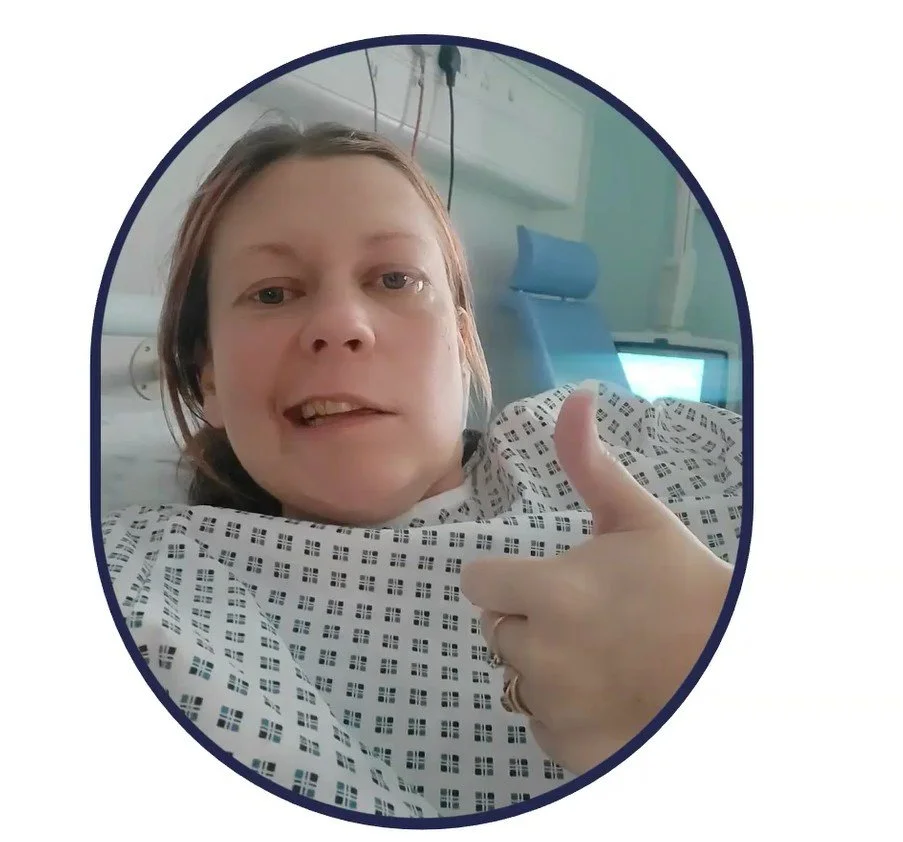
In hospital
Getting better was not overnight. And I had to learn that the hard way.
When I came out of the hospital after three and a half months, my body had deconditioned significantly. I had gone from being an active person to someone who could not walk to the end of a corridor without struggling. I started with physiotherapy and hydrotherapy. For a while, I needed a crutch, then a walking stick. My mind wanted to race ahead. I wanted everything back at once: my hearing, my fitness, my social life, my job. But the reality is you have to take it one step at a time.
Fatigue is now a permanent part of my life. Everything I do comes with a consequence. Six months ago, I could not walk around a supermarket without crying because my legs ached so much. I had to sit down in the shower because I could not stand long enough. Cleaning the house, which used to take me a day, now has to be spread across two rooms at a time.
The biggest challenge was the disconnect between my mind and my body. My mind was still telling me I could do everything I used to do. My body was telling me otherwise. Learning to listen to my body, and to stop before I hit a breaking point rather than after, has been one of the most important things I have had to figure out.
The way I approach it now is trial and error. I find my baseline, I do a little more each time, and I stop before I suffer. If I think I can do three rooms of housework, I stop at two. If I can probably walk a bit further, I will stop a little before that. It is not giving up. It is protecting tomorrow. But then I also try to gently nudge forward when I can, and that’s also helped build me up. I’ve never given up trying to do more. I’m just better at balancing it now, and that’s really helped.
I am now walking unaided. No crutch, no stick. I can cover a couple of miles. I still get breathless, and sometimes I need to rest, but that is just pacing. It is all part of the process.
I also had to adapt to my new hearing. My right ear is completely deaf. It now works as a microphone that picks up sound and crosses it over to my left ear via a hearing aid. I fully rely on these to hear. Getting fitted and learning to use them properly was another part of the rehabilitation journey that people do not always think about.
Going Back to Work
Returning to work was the part I was most nervous about. I had been off for seven months, four of them in hospital. There is a real fear when you have been away that long: will I be able to do it? Will people treat me differently? Will I manage?
“But here is what I know now: the longer you stay off, the harder it becomes to go back.”
Going back to work was, without question, the best decision I made.
I returned in September 2025, doing just two hours a day for the first week. The following week it went up to three hours, then four. Slowly and steadily, I built it up. It took until December to get back to full time hours, and every single step of that process mattered.
Before I went back, I sat down with Jessica from Vitality360, my manager and my occupational health advisor, and we mapped out my work tasks using a traffic light system. Green for tasks I could do straightaway, like emails and simple admin. Amber for tasks that needed a bit more thought or adjustment. Red for things that were a no-go for now. That structure gave me something to hold onto. It meant I was not just thrown back in and left to figure it out. It meant my employer knew exactly what I needed and could plan around it. We carefully planned a return to work and monitored it regularly.
The workplace adjustments made a real difference, too. I wear a microphone around my neck that connects to my laptop so I can follow Teams calls, because I cannot use earphones in my ears. I have a blue badge parking space, so I am not exhausted before I even get to my desk. I have access to a disabled toilet and a buddy system in place so that if the fire alarm goes off, someone is always with me to help me down the stairs from the third floor, because I cannot use a lift in an emergency. These things sound small, but they add up to feeling safe and supported at work.
My employer has been brilliant. They were accommodating, patient, and never made me feel like a burden. That matters more than I can say.
"Getting back into work was the best thing I did. It was the final part of my journey to get back into normality."
Coming back to work was not just about the job. It was about seeing my colleagues again. Having a routine. Having somewhere to be. Having something to focus on outside of illness.
“Work was part of my healing just as much as the physiotherapy and the medication. The socialising, the routine, the sense of purpose. It all counts.”
Getting My Life Back
The small things matter more than you would think.
I used to love music. When I lost my hearing, I lost my love for it because it sounded wrong in one ear, and it was not the same. So I just stopped. But music is part of who I am. So eventually I made myself start again. I learnt to hear it differently. And a couple of weekends ago, I went to karaoke for the first time in years. I cannot hear myself sing anymore. The music plays through my hearing aid, and I have no idea what I sound like, but I got up there anyway.
"I don't know what I sounded like at the Karaoke! I couldn't hear it, but everyone said it was good."
I am back watching my rugby team home and away. I am seeing friends every weekend. I am back at work full-time. And I am currently building up to walking a 5K unaided. I never ran before any of this, and I am certainly not starting now, but I will walk it!
"You can go from being at your lowest point, not wanting to be here, not wanting to carry on, to this. Living your best life. I've accepted, I've grieved, and I've moved on."
Heather’s advice if you’re going through something similar:
1. Don't wait until you feel 100% to start living again.
Your new 100% might be 80%. That is okay. Start your recovery. Get back into a routine. Do not sit waiting for something that may never come.
2. Grieve, and then accept.
You might have lost something real. Grieve for it. Feel it. And then accept your new reality. It is not giving up. It is moving forward.
3. A phased return to work is worth it.
Nobody is asking you to go back and work a full seven-hour day straight away. Two hours a day is a valid starting point. Build it up. Ask for adjustments. Routine and human connection are part of your recovery, even if it does not feel like it at first.
4. Use a traffic light system for your tasks.
Whether that is work tasks, household chores, or social commitments. Green, amber, red. Know what you can do now, what needs a little adjustment, and what is a no-go for the moment. It takes the guesswork out and helps the people around you understand what you need.
5. Pace yourself, even when your mind says you can do more.
Stop before you reach your limit. Build slowly. Trial and error is the only way to find your baseline, and protecting tomorrow is just as important as making progress today.
6. You do not have to do it alone.
I could not. I have had a team of specialist professionals around me: physiotherapy, CBT therapy, occupational health support, hydrotherapy, and, of course, my medical team. There is help out there. Seek it and accept it.
7. Get back to the small things that make you you.
For me it was music and rugby. For you it might be something completely different. But those things are part of your identity, and getting them back is part of your healing.
8. Record your progress.
I filmed my journey, videos in my hospital bed, walking the corridors, trying to eat a yoghurt. Now I look back at those and see how far I have come. On the hard days, that is the most powerful reminder of all.
A Final Word
If you are where I was, in pain, exhausted, not wanting to carry on, I want you to know that it can change. It will not be easy. It will not be quick. But it can change.
"This is my new 100%. This is my new life."
And it is a life worth fighting for.
Want to watch Heather tell her story in her own words? Head over to the Vitality360 case story page here to see the full video and hear more stories like hers. You will also see photos and videos that she took recording her journey.